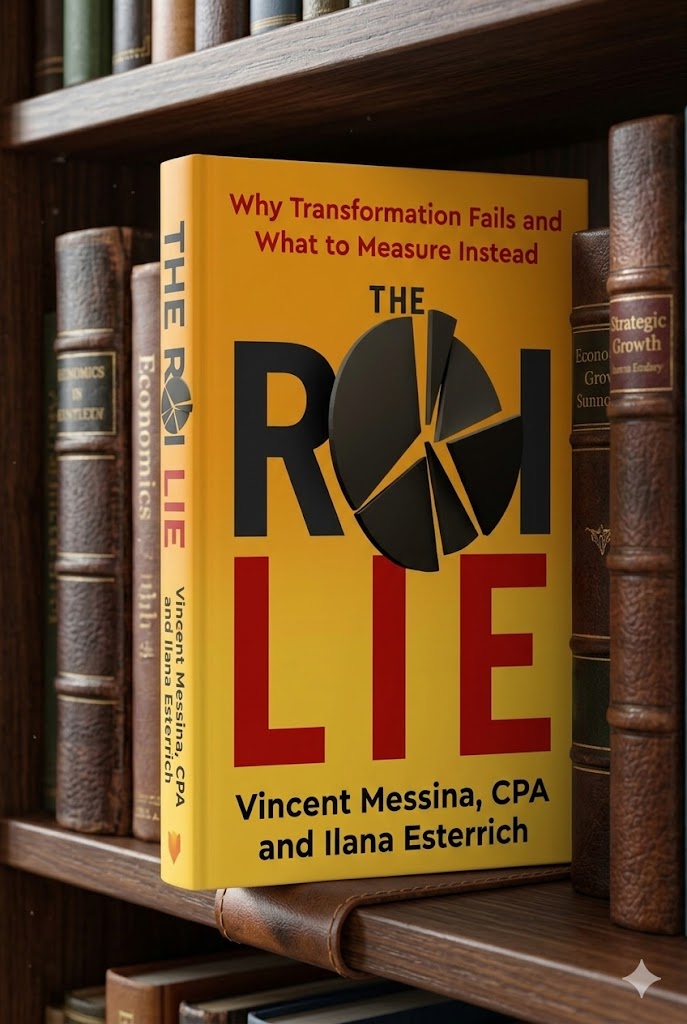
The ROI Lie: Why Transformation Fails and What to Measure Instead
By Vincent Messina, CPA & Ilana Esterrich
Most transformation programs don't fail because the technology is wrong. They fail because the organization fails to calculate the real value of change, the capacity to absorb it and key stakeholders agreement on both. Yet leaders still approve initiatives using the same metric designed for buying factory equipment a century ago. ROI measures the purchase. It doesn't govern the change. This book explains why.
Transformation has become the corporate version of Groundhog Day. Every year a new initiative launches with confident projections and a polished ROI slide. Every year the organization absorbs another wave of change that promises reinvention and delivers exhaustion. Teams juggle competing priorities, initiatives quietly stall, and leadership moves on to the next transformation before the last one finishes.
The problem is rarely the technology. The problem is how the decision was made in the first place.
For more than a century, organizations have relied on Return on Investment to decide which initiatives deserve funding. ROI works well for evaluating purchases. It works poorly for evaluating change. Transformation does not fail because the investment was wrong. It fails because the organization never had the capacity to absorb the change.
ROI measures the purchase.
It does not measure the real value of change and whether the organization will actually achieve it.
That gap explains why so many transformation programs look rational on paper and collapse in practice.
The ROI Lie argues that leaders need a different lens for evaluating transformation. Instead of asking whether an initiative produces a financial return, leaders should ask whether the organization can survive the change required to produce that return.
You've Seen This Movie Before
"Transformation launches with a confidence ROI slide. Six months later, the initiative is 'slowing down'"
Teams are juggling three other priorities that leadership approved after the kickoff. The technology works. The organization doesn't change. Finance ends up absorbing the risk.
This isn't a change management problem. It's a measurement problem.
Readers will learn how to...
- •Leverage a simple model to bridge the gap between traditional governance work, and work that drives strategic value.
- •Use Attention as the driver that optimizes The Value Diamond to assess the actual value delivered to your organization against the ability to enhance it by evolving the way you work through technology and change.
- •Deploy practical tools used by executive teams to assess the real value of change, evaluate transformation readiness, clarify decision rights, protect organizational focus, and ensure that change survives contact with reality.
- •The book introduces practical tools used by executive teams to evaluate transformation readiness, clarify decision rights, protect organizational focus, and ensure that change survives contact with reality.
The Three Questions Decision Funnel
ROC replaces ROI's narrow focus with three questions that predict whether change will stick:
- Why change at all? What is the cost of not changing, and is that cost high enough to justify the disruption?
- How will we change? What behaviors will shift, who will change them, and what work will stop?
- Why this solution? Which solution best enables the specific behavior changes we need?
Practical Frameworks
Concrete tools to diagnose readiness, protect focus, and stage change:
- The Value Diamond
- ROC Consensus Map
- Capacity Contracts
- Decision Rights Maps
- Minimum Viable Change
- The Attention Audit
"You do not get a return on technology. You get a return on change."
And that return starts the moment you decide to lead attention differently.
Beyond the Book
The ROI Lie is the field guide. Attention Shift Operating Strategies is where the framework gets put to work. Founded by Ilana Esterrich and Vin Messina, AS|OS is the advisory practice built around Return on Change, helping CFOs, transformation leaders, and the vendors who serve them govern attention, reduce decision latency, and make change actually hold. If the book is describing your organization, that is usually a sign worth following.
Be the First to Know
Join the pre-order list and get notified the moment the book is available for purchase.
Ready to Transform How You Lead Change?
Stop celebrating approvals. Start measuring what actually worked.